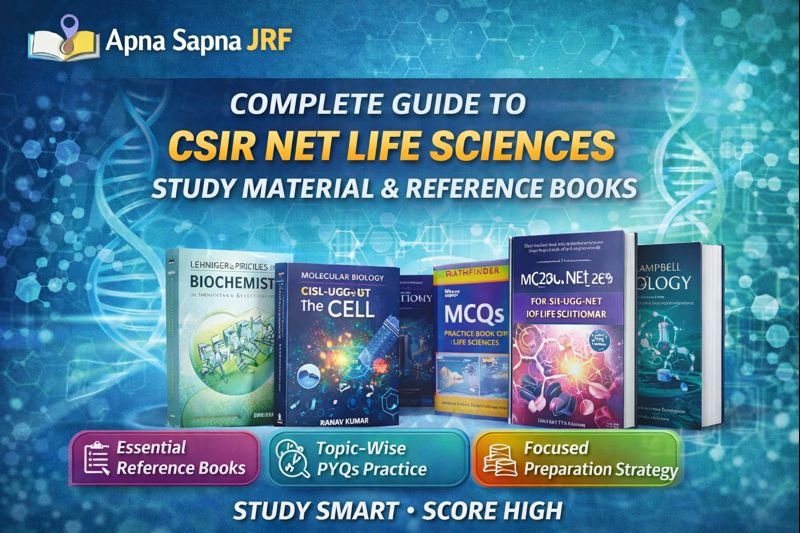
The CSIR NET Life Sciences exam, conducted by the National Testing Agency (NTA), is held twice a year—usually in June and December. One of the most common questions aspirants ask is:
“Which books should I study for CSIR NET Life Sciences?”
While online resources are helpful, standard textbooks and well-designed practice books remain essential for building strong concepts and performing well in Parts B and C.
This guide from Apna Sapna JRF gives you a unit-wise, realistic book strategy—so you don’t waste time reading everything blindly.
How to Choose the Right Study Material (Important First)
Before jumping into book lists, understand this clearly:
- ❌ You do not need to read every standard book cover-to-cover
- ✅ You do need conceptual clarity + exam-oriented practice
- 📌 Book selection depends on time available and preparation level
We’ll cover both standard reference books and practice resources, with honest guidance on how to use them.
Part A – General Aptitude (CSIR NET)
Recommended Book
- General Aptitude – Theory & Practice
(Covers quantitative aptitude, reasoning, and basic mathematics)
📌 Tip: Practice regularly, but don’t overinvest time here. Part A supports your score—it doesn’t carry it.
Part B & C – Unit-Wise Reference Books (Life Sciences)
Below is a unit-wise reference framework. Use these books for concept clarity, not memorization.
Unit 1 – Biomolecules & Catalysis
- Lehninger Principles of Biochemistry
- Principles of Biochemistry – Nelson & Cox
- Voet, Voet & Pratt
Unit 2 – Cell Biology
- Molecular Biology of the Cell – Bruce Alberts et al.
- The Cell: A Molecular Approach – Cooper & Hausman
Unit 3 – Molecular Biology
- Molecular Biology of the Gene
- Lewin’s Genes
- Watson, Baker, Bell, Gann, Levine & Losick
Unit 4 – Immunology
- Kuby Immunology
- Standard immunology textbooks for mechanisms & pathways
Unit 5 – Developmental Biology
- Developmental Biology – Scott F. Gilbert
Unit 6 – Plant Physiology & Development
- Plant Physiology – Taiz & Zeiger
Unit 7 – Human & Animal Physiology
- Textbook of Medical Physiology – Guyton & Hall
- Principles of Animal Physiology – Moyes & Schulte
Unit 8 – Genetics
- Principles of Genetics – Klug & Cummings
- Genetics: A Conceptual Approach – Benjamin A. Pierce
Unit 9 – Diversity of Life / Microbiology
- Campbell Biology
- Prescott’s Microbiology
Unit 10 – Ecology
- Elements of Ecology – Smith & Smith
Unit 11 – Evolution
- Evolution – Futuyma & Kirkpatrick
Unit 12 – Biotechnology
- Principles of Gene Manipulation & Genomics
- Plant Breeding: Principles and Methods – B.D. Singh
Unit 13 – Biophysics & Molecular Biology Techniques
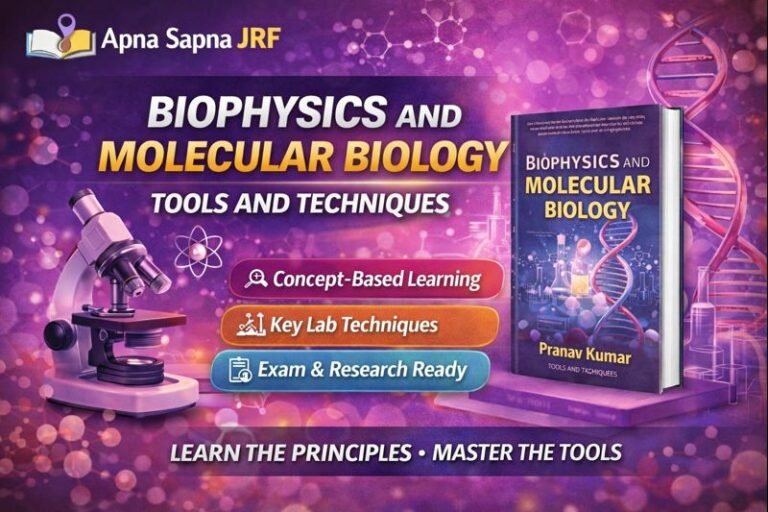
- Biophysics & Molecular Biology – Tools and Techniques
- Gene Cloning and DNA Analysis – T. A. Brown
- Principles & Techniques of Biochemistry and Molecular Biology – Wilson & Walker
📌 Important: For Unit 13, conceptual understanding + application matters far more than theory volume.
Practice Books & PYQs (Most Important for Selection)
No aspirant clears CSIR NET without PYQ-based practice.
What You Must Practice:
- Topic-wise MCQs
- Previous Year Questions (PYQs)
- Concept-based analytical questions (Part C level)
Practice books help you:
- Understand question framing
- Identify high-weightage areas
- Improve accuracy and confidence
Should You Read All These Books?
Honest Answer: No — unless you have a full year
If you have 1 year or more:
- Use standard reference books for deep understanding
- Combine with PYQs and mock tests
If you have limited time (4–6 months):
- Use exam-oriented, condensed books
- Focus more on PYQs, MCQs, and revision
- Avoid jumping between too many sources
Too many books = confusion.
Right books + practice = results.
CSIR NET Life Sciences – Book FAQs
Are exam-oriented books enough to clear CSIR NET?
They are sufficient for structured preparation, provided you:
- Understand concepts properly
- Practice PYQs consistently
- Revise regularly
Do I need standard textbooks?
Standard books are helpful for:
- Weak units
- Conceptual clarity
But reading all of them fully is not mandatory.
What matters more: books or practice?
👉 Practice. Always.
Most selections happen because students solve questions smartly, not because they read more books.
How Apna Sapna JRF Recommends Studying
At Apna Sapna JRF, we guide students to:
- Study unit-wise, not randomly
- Combine concept learning + PYQs
- Focus on Part B & C logic
- Revise strategically instead of rereading books
Books are tools — strategy decides success.
Final Takeaway
There is no “perfect” book list that guarantees selection.
What works is:
- Right books
- Clear concepts
- PYQ-driven practice
- Consistent revision
If you study smart, even limited resources are enough.