
Biophysics lies at the intersection of physics, biology, and chemistry, providing powerful tools to understand life at the molecular and cellular level. From protein structure analysis to molecular imaging and spectroscopy, biophysics plays a critical role in modern research, medicine, genetics, and biotechnology.
For students preparing for CSIR NET, GATE, MSc exams, or advanced life science studies, understanding biophysical tools and techniques is no longer optional — it is essential.
Why Biophysics Matters in Life Sciences
Biophysics helps answer questions that traditional biology alone cannot, such as:
- How do proteins fold and interact?
- How can we visualize molecules inside cells?
- How do physical forces influence biological systems?
That’s why biophysics forms an important part of Life Science, Biotechnology, and Molecular Biology syllabi, especially in competitive exams.
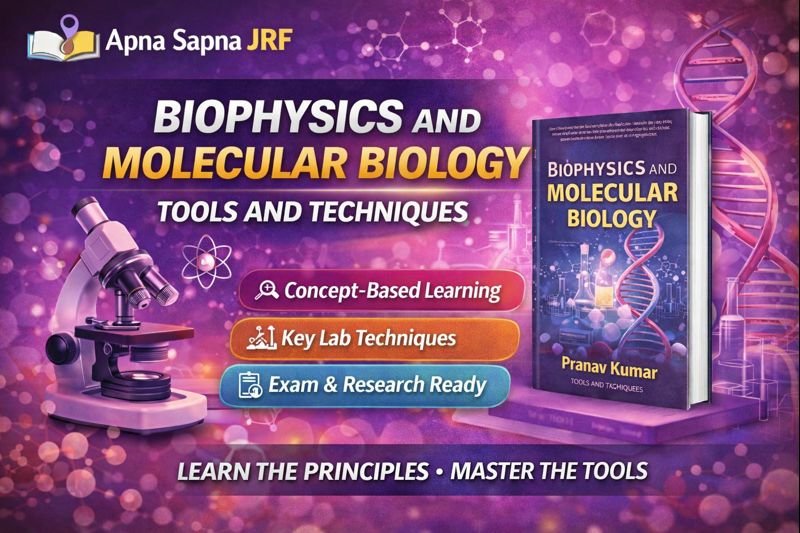
Biophysics and Molecular Biology – Tools and Techniques
Author: Pranav Kumar
Best For:
Students preparing for CSIR NET Life Science, GATE Biotechnology, MSc exams, and those aiming for strong conceptual clarity in molecular and biophysical techniques.
One of the most widely recommended resources in this area is Biophysics and Molecular Biology – Tools and Techniques by Pranav Kumar, an experienced educator in Life Sciences and Biotechnology.
What Makes This Book Stand Out?
This book is valued because it focuses on understanding techniques, not just memorizing definitions.
1. Strong Balance of Theory and Application
Each technique is explained with:
- The scientific principle behind it
- How and why the technique is used
- Where it fits in real experimental setups
This approach is extremely helpful for exam-oriented questions and conceptual MCQs.
2. Focus on Conceptual Understanding
Instead of rote learning, the book emphasizes:
- Mechanisms behind experimental tools
- Logical reasoning for selecting techniques
- Clear differentiation between similar methods
This is particularly useful for CSIR NET Part B & C questions.
3. Simplified Explanation of Laboratory Techniques
Complex tools such as spectroscopy, microscopy, centrifugation, and molecular analysis methods are broken down into clear, step-by-step explanations, making them easier to understand even for beginners.
Who Should Use This Book?
This book is suitable for:
- Beginners starting biophysics for the first time
- MSc students looking to strengthen practical concepts
- CSIR NET & GATE aspirants needing clarity in tools & techniques
- Students struggling with experimental-based questions
By combining the “why” and the “how”, the book helps bridge the gap between theory and laboratory application.
How Apna Sapna JRF Recommends Using This Resource
At Apna Sapna JRF, we advise students to:
- Study tools & techniques conceptually, not as isolated facts
- Link biophysical techniques with previous year questions (PYQs)
- Focus on application-based understanding for higher-level questions
Resources like this book work best when combined with guided lectures, PYQ discussion, and regular revision.
Final Takeaway
Biophysics and molecular biology techniques form the backbone of modern life science research and competitive exams. A resource that explains both principles and applications can significantly improve understanding and exam performance.
For serious aspirants, mastering these tools is a long-term investment in both exams and research careers.